What Kinds of Questions Can Science Investigate, and Which Cannot Be Answered by Science Alone?

Summary
What makes a question scientifically testable? Through examples ranging from sunsets to plant experiments, this article explores how science uses evidence to investigate the world—and why questions about values, beauty, and meaning require more than scientific evidence alone. It distinguishes “we don’t know yet” from questions that lack a clear way to be tested, and shows how refining a question can open a path to investigation.
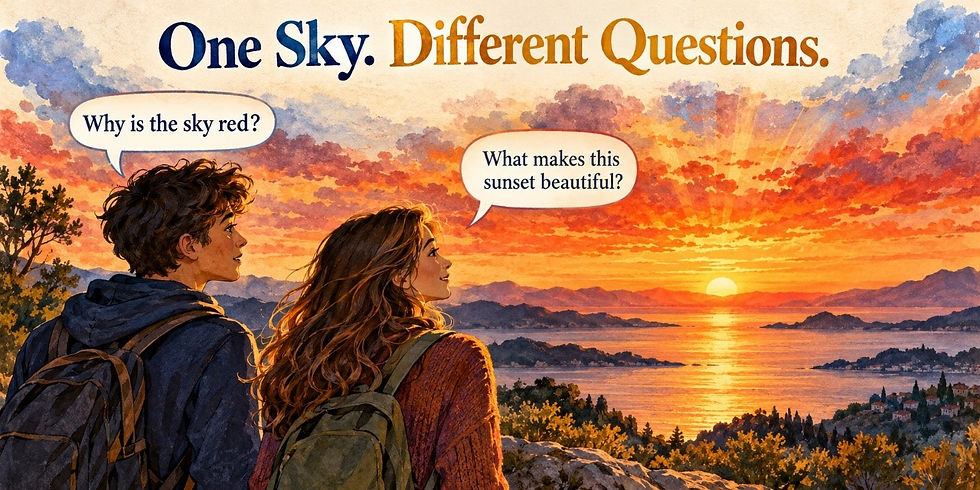
Imagine a friend and I looking at the same evening sky. I ask, “Why has the sky turned red?” My friend says, “That sunset is beautiful.”
We are talking about the same sky, but we are raising different kinds of questions.
We can explain why the sky turns red by studying sunlight, the atmosphere, and the scattering of light. But to decide whether this sunset is “the most beautiful,” we first need to ask: Beautiful to whom? And what would count as “the most beautiful”?
This makes me realize that before searching for an answer, it is worth asking: What kind of answer does this question need?
How Can Science Investigate a Question?
Scientific investigation usually requires connecting a question to evidence we can examine. Through observation, measurement, experiments, or comparisons between the predictions of different explanations, we can judge which explanation best fits the evidence.
For example, suppose I want to know: “Does sunlight affect plant growth?”
I could choose plants of the same species, expose them to different amounts of light, keep their water, soil, and other conditions as similar as possible, and record their growth. Using enough plants and repeating the experiment would help me judge the effect of light more reliably.
There are several important steps here: turning “affects growth” into something measurable, comparing different conditions, and considering other factors that might influence the results. Measuring how much taller the plants grow might tell us something different from counting their leaves. Observing just one plant would also make it difficult to rule out chance.
By refining a broad question in this way, we give ourselves a clearer path for investigating it.
However, a question does not have to involve something we can recreate in a laboratory to be studied scientifically.
We cannot make a real star and then wait billions of years to watch it change. But we can observe stars at different stages, analyze the light they emit, and test whether models of stellar evolution agree with those observations.
Likewise, we cannot rerun the entire history of Earth, but we can study rocks, fossils, and other evidence left behind.
What matters is that an explanation connects to evidence and that there is a way to test it.
Can We Study Things We Cannot See?
Yes. We do not have to see something directly to investigate it.
We cannot see wind, but moving leaves and instruments that measure airflow provide evidence of it. We cannot see atoms with our unaided eyes, but many kinds of experiments allow us to investigate their behavior.
Sadness, pain, and memory cannot be placed on a table like stones. Still, researchers can study them by combining people’s reports, observations of behavior, and measurements of activity in the body or brain. Each method has limitations, so the results need careful interpretation.
Science is therefore not limited to things we can touch or see. The more important questions are: What evidence can we obtain, and what conclusions can that evidence support?

Why Can’t Science Answer Some Questions on Its Own?
Suppose a new technology could reduce traffic congestion in a city, but it would need to collect records of everyone’s journeys.
Scientific and technical research could help us find out how much congestion it might reduce, how vulnerable the data would be to leaks, and whether alternatives could collect less information.
But deciding how much privacy we should give up for convenience also involves values. Some people place greater importance on efficiency, others on privacy, and others on who has the right to use the data.
To make a decision, we need evidence as well as discussion about rights, fairness, and responsibility.
Science can help us understand the likely consequences of different choices. Deciding which outcomes are worth pursuing and which costs are acceptable also requires ethical reasoning and discussion. Even when people have the same data, they may make different choices because they value different things.
Questions about beauty and the meaning of life have similar features. Science can investigate why people enjoy certain kinds of music and how music affects emotion. But “Which song means the most to me?” and “What kind of life do I want to lead?” also involve personal experiences, relationships, and aspirations.
These questions still deserve serious thought. We can give reasons and compare viewpoints, but we cannot expect a single experiment to make the final choice for everyone.
How Is “We Don’t Know Yet” Different from “Science Alone Cannot Answer This”?
These two situations are easy to confuse.
“Does life exist beyond Earth?” is a question for which we can seek evidence. It is difficult to answer, but we can study environments on other worlds and look for signs that might be associated with life. Not having a definite answer yet does not place the question beyond scientific investigation.
Other questions may not be clear enough as currently phrased. For example: “Does this machine really understand me?” We need to clarify what “understand” means. Does it mean answering questions accurately, recognizing emotions, or having some kind of subjective experience? Different meanings call for different methods of investigation and may leave us with different uncertainties.
If a claim is defined so that no possible observation could test it or change how credible we consider it, then it is difficult to investigate as a scientific hypothesis. That does not, by itself, prove the claim true or false. It means we lack a way to evaluate it through scientific evidence.
Finding a Better Way to Ask
When I encounter a big question, I can try breaking it into smaller ones.
“Are phones good or bad?” is difficult to answer directly. But “Does using a phone before bed affect how long it takes to fall asleep?” gives us a clearer direction for research.
“What is the best way to live?” involves many value judgments. But “Which daily habits are associated with better sleep?” can be investigated scientifically.
Once we separate the parts, we often discover that a question contains a mixture of facts, predictions, and value judgments. Addressing them separately makes the discussion clearer and helps us avoid expecting science to do something it cannot accomplish alone.
When I read a question, I want to ask myself:
What exactly do I want to know?
What evidence could help me judge?
What result would make me change my mind?
Does this question also require thinking about values, meaning, or personal choices?
Science gives us ways to test many of our ideas about the world. Understanding its scope helps us use it appropriately.
A good investigation often begins by making the question clear.
留言