What Is the Difference Between a Scientific Fact, a Hypothesis, a Theory, and a Law?

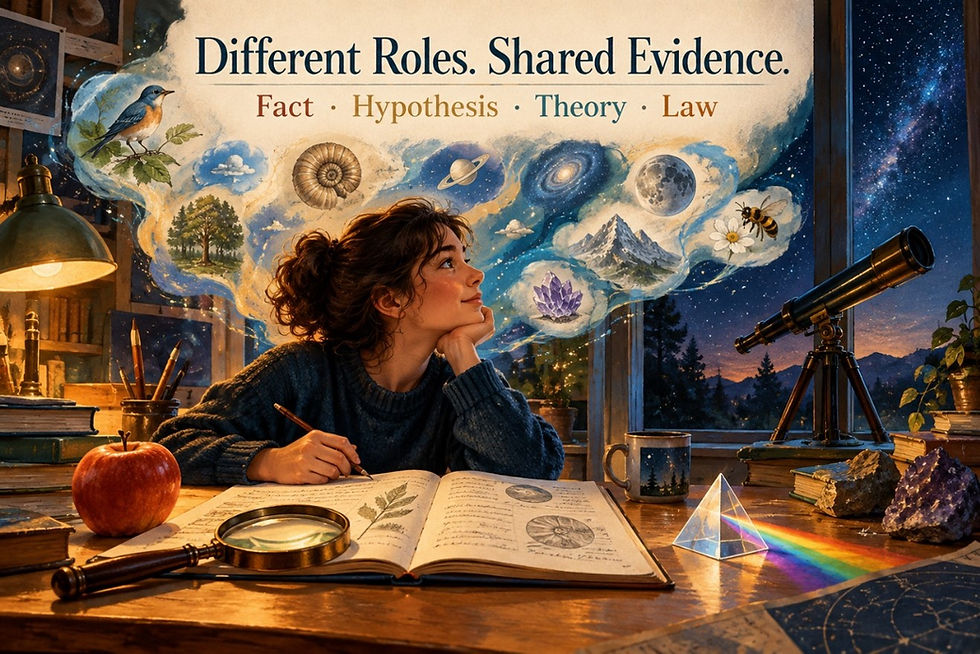
Summary: What makes a scientific theory different from a guess—and does it ever become a law? This article explores the distinct roles of facts, hypotheses, theories, and laws through everyday examples and a simple gas experiment. Rather than forming a ladder of increasing certainty, they work together to describe, test, and explain the natural world. Understanding these differences helps us evaluate scientific claims by their evidence, predictions, and limitations.
When someone says, “That’s just a theory,” they often mean, “That’s only a guess.”
In everyday conversation, that makes sense. I might have a “theory” about why a friend missed the bus without having much evidence. In science, however, the word has a different meaning. A scientific theory can be a powerful explanation supported by many independent lines of evidence.
To understand the difference, it helps to look at four terms scientists use: fact, hypothesis, theory, and law. They have different roles—and they are not steps on a ladder from uncertain to certain.
A Fact: Something Reliably Established
A scientific fact is an observation or finding supported so reliably that we can generally accept it as a starting point for further investigation.
For example, objects released near Earth’s surface fall when nothing supports them. Water molecules contain hydrogen and oxygen. Earth orbits the Sun.
Some facts are established through direct observations. Others require instruments and careful interpretation. We do not need to see something with our own eyes for it to be well established.
Conditions also matter. “Water boils at 100°C” sounds like a simple fact, but it needs a qualification: this is approximately true for pure water at standard atmospheric pressure. Change the pressure, and the boiling temperature changes.
Calling something a fact does not mean every measurement is exact or every description is complete. It means the evidence supporting it is strong.
A Hypothesis: An Idea We Can Test
A hypothesis is a proposed explanation or claim that can be evaluated using evidence.
Suppose I notice that a plant near a window grows more than one in a dark corner. I might suggest:
Within a suitable range, receiving more light increases the growth of this kind of plant.
That is a hypothesis. It offers an explanation that I can investigate.
I could grow several plants of the same species under different light conditions while keeping water, soil, temperature, and other factors as similar as possible. I would also need to decide how to measure growth: height, leaf number, or perhaps total mass.
My hypothesis would then lead to a prediction: under the conditions I have specified, the plants receiving more light should show greater growth.
The result might support the hypothesis, challenge it, or suggest that it needs refinement. Perhaps extra light helps only up to a point. Perhaps another factor matters more than I expected.
A hypothesis does not have to be a wild guess. It can arise from previous research and careful observation. What matters is that evidence can help us assess it.
A Theory: A Broad Explanation Supported by Evidence
A scientific theory explains a substantial set of observations and findings. It connects evidence into a framework that helps us understand how or why something happens.
The theory of evolution explains patterns of biological change and common ancestry. The kinetic theory of gases explains many properties of gases in terms of moving particles. General relativity explains gravity through the geometry of spacetime.
These theories do more than explain what scientists already know. They also generate predictions that can be tested.
For example, a theory about moving gas particles can help predict how a gas’s pressure will change when its temperature changes under specified conditions. Agreement between predictions and measurements strengthens confidence in the explanation.
Scientific theories can be revised, extended, or replaced when evidence demands it. They can also remain useful within a limited range even when a broader explanation becomes available.
The word “theory,” by itself, does not tell us how strong the evidence is. We still need to examine its support, successful predictions, and limitations. But dismissing an established scientific theory as “just a guess” misunderstands what the term means.

A Law: A Description of a Regular Relationship
A scientific law describes a regular relationship in nature, often using mathematics.
For example, Newton’s second law relates force to changes in momentum. For an object with constant mass, its familiar form is:
[F_{\text{net}} = ma]
This tells us how net force, mass, and acceleration are related within the conditions where Newtonian mechanics applies.
Boyle’s law gives another example: for a fixed amount of gas at constant temperature, pressure increases as volume decreases. It is a useful approximation for real gases under suitable conditions.
A law can help us calculate and predict what happens. A theory provides a broader framework for understanding the relationship.
However, this distinction is a guide rather than a rigid rule. Scientific terminology developed over a long history, and laws and theories can overlap in what they describe and explain.
Importantly, a scientific law is not a command that nature must obey. It is our statement of a pattern found in nature. Its scope must be checked against evidence.
Does a Hypothesis Become a Theory, Then a Law?
It is tempting to imagine this sequence:
Hypothesis → Theory → Law
But science does not work through that simple hierarchy.
A hypothesis may contribute to a theory when it becomes part of a broader, well-supported explanation. It may also be rejected, revised, or remain a narrow claim.
A theory does not eventually become a law by collecting enough evidence. Laws and theories serve different purposes. A law can describe a relationship that a theory helps explain.
The kinetic theory of gases, for instance, helps explain why relationships such as Boyle’s law arise. One is not an upgraded version of the other.
Likewise, a fact does not become a theory. The observation that a gas’s pressure changes is different from an explanation of why it changes.
One Example, Four Roles
Imagine studying a gas in a sealed container with a movable piston.
Term | Its role in the investigation |
Fact | Repeated measurements establish that compressing the gas at a fixed temperature increases its pressure under the tested conditions. |
Hypothesis | Moving gas particles exert pressure by colliding with the container’s walls. |
Theory | The kinetic theory of gases connects particle motion to pressure, temperature, and other gas properties. |
Law | Boyle’s law describes the approximate relationship between pressure and volume for a fixed amount of gas at constant temperature. |
The same investigation can involve all four. Together, they help us move from observing a pattern to testing an explanation and making predictions.
What Should I Ask When I Encounter These Words?
Rather than judging a claim by its label alone, I can ask:
What evidence supports it?
What does it describe or explain?
What predictions does it make?
Under what conditions does it apply?
What findings would require us to revise it?
Facts give us reliable findings. Hypotheses give us ideas to test. Theories connect evidence into explanations. Laws describe regular relationships.
Understanding their roles helps us ask better questions about both what we know and how we know it.

留言